

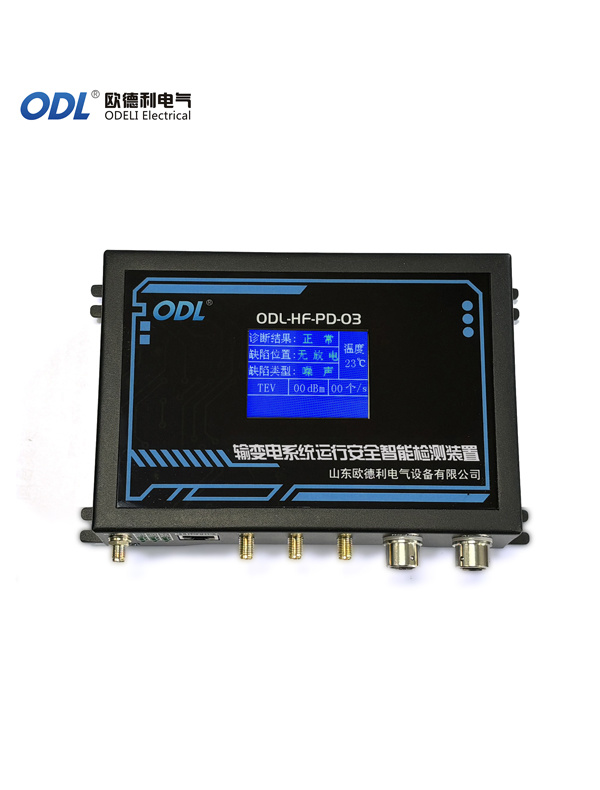


Insulation testing device
Classification:
keyword:
Product Description

1. TEV (Transient Earth Voltages)
Transient-to-ground voltage
When partial discharge occurs in high-voltage electrical equipment, the discharge quantity tends to accumulate first in the grounded metal parts adjacent to the grounding point, forming a ground current that propagates along the surface of the equipment’s metal components. In the case of internal discharge, the accumulated discharge quantity concentrates on the inner surface of the grounding shield. If the shield is continuous, no partial discharge signals can be detected externally. However, since the shielding layer is often discontinuous at certain insulation points, partial discharge signals can then propagate through these discontinuities into the equipment’s shielding enclosure. The electromagnetic waves generated by the partial discharge escape through the joints of the metal enclosure or through the gaskets of gas-insulated switchgear and continue to propagate along the outer surface of the equipment’s metal enclosure, simultaneously inducing transient voltage pulses relative to ground.
In theory, the TEV method boasts high sensitivity and strong anti-interference capabilities. However, given the numerous interference sources present at substation sites, TEV measurements can still be affected by external disturbances. During testing, it is generally accepted that test data exceeding 20 dB—10 dB above the background level—and discharge pulses... When the discharge count is between 50 and 1000, it can be considered that partial discharge is present within the switchgear.
2. Ultrasonic testing method (AE)
The acoustic signals generated by partial discharge are primarily concentrated in the frequency range of 0 to 100 kHz. However, the frequency spectrum of interference signals generally lies within the 0 to 40 kHz range. Voice interference signals exhibit spectra concentrated below 10 kHz, and vibrations as well as background noise also predominantly occur within this frequency band. Therefore, when partial discharge occurs inside a switchgear cabinet, it produces shock vibrations and sound waves that quickly propagate through the surrounding medium. We can detect partial discharge by acquiring ultrasonic signals in the frequency band of 20 to 100 kHz. Based on this principle, specialized equipment has been developed to detect partial discharge in electrical devices such as switchgear cabinets, overhead lines, transformers, and GIS switchgear. By analyzing the ultrasonic signal spectrogram and the characteristic sound waves emitted during partial discharge, we can accurately determine both the magnitude and location of the partial discharge in the device under test. When ultrasonic testing detects signals that appear to be indicative of partial discharge, the likelihood of actual partial discharge occurring inside the switchgear cabinet is quite high. Generally, it is considered that if the ultrasonic test reading exceeds 6 dB, partial discharge is likely present.
3 . High Frequency Detection technology
The insulators in power equipment exhibit both high dielectric strength and high breakdown field strength. When partial discharge occurs within a very small region, the breakdown process happens rapidly, generating a steep pulse current with a rise time shorter than 30 nanoseconds and exciting high-frequency electromagnetic waves. The fundamental principle of the high-frequency method for partial-discharge detection lies in using HF sensors to detect the ultra-high-frequency electromagnetic wave signals generated during partial discharge in power equipment, thereby obtaining relevant information about the partial discharge and enabling its monitoring. Since corona interference at the site is primarily concentrated below the 100 MHz frequency band, the HF method can effectively avoid such interference as corona, exhibiting high sensitivity and strong anti-interference capability. This method offers advantages such as live partial-discharge detection, location determination, and identification of defect types.

Host
The monitoring host is installed in the switchgear room or substation and housed within the main control cabinet. It consists of multiple modules, including a CPU module, a high-speed data acquisition module, a communication module, a clock module, and a power supply module. It features a compact size and high level of integration.
High-frequency current transformer
The cable’s grounding wire passes through the magnetic ring and connects the magnetic ring to the host chassis. A high-frequency current transformer is used to measure the high-frequency ground-current signal generated by partial discharge.
Ultrasonic sensor
The ultrasonic sensor is installed on the inner side of the cabinet (magnetic attachment type) to measure the ultrasonic signals generated by partial discharge.
High-frequency electromagnetic wave sensor
Installed on the inner side of the cabinet (magnetic suction type), it measures the electromagnetic wave signals generated during discharge.

●This monitoring system consists of two main components: sensors and an intelligent monitoring terminal. The sensors include three types: current transformers, spatial electromagnetic field sensors, and ultrasonic sensors.
● The sensor collects the corresponding signal and transmits it to the intelligent monitoring terminal via a coaxial cable.
●The intelligent monitoring terminal consists of three main components: a digital signal processing module, a data analysis module, and a signal transmission module.
● The signal processing module has three channels, corresponding to the connection of three types of sensors. It performs filtering and sampling based on the signal characteristics of different sensors.
● The data analysis module includes a device alert algorithm that performs comprehensive analysis of the collected data to determine whether an alert should be generated.
● The signal transmission module includes a WiFi module, an Ethernet module, and a 485 module. Depending on the on-site network conditions, you can choose the most convenient access method. After connecting to the network, the monitoring information is transmitted to the system backend via an aggregation switch.


Related products
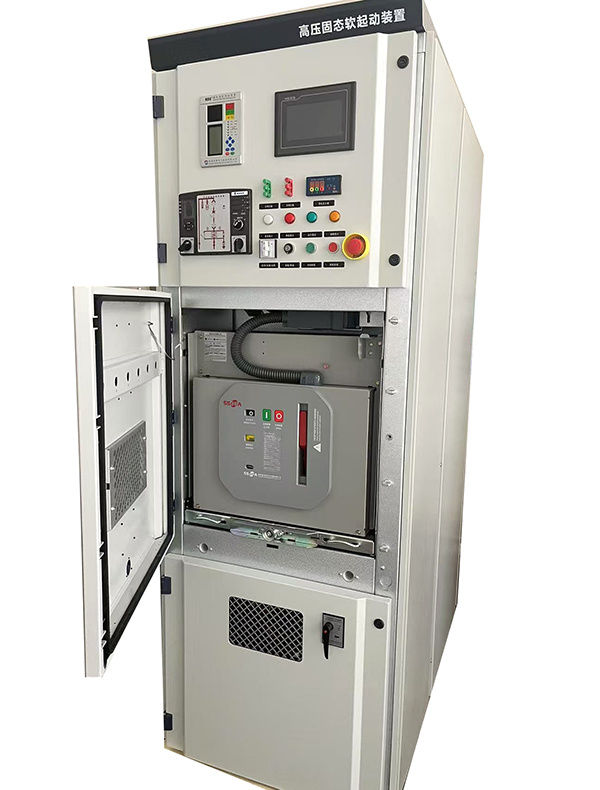
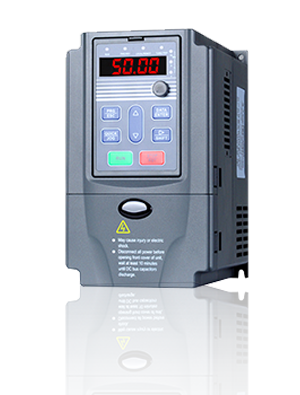


Related products